Let’s chat.
We’d love to learn more about you and your business.
Think of coding AIs as brilliant new junior programmers. You can see that they have mad skills, but they wander, forget what they decided yesterday, and occasionally ignore you entirely because they think they’ve found a “better way.” In other words: smart, fast, and absolutely in need of supervision.
That’s why AI coding is absolutely pair programming. If you tell AI to write a spec, you have to read the spec and approve it before moving on. If you have AI write a technical design, same thing. And if you tell AI to write code? First, never give it carte blanche to run any script, unless you want all of your files to be deleted by accident. Review the plan, approve every step, and keep an eye on what it’s doing. Every time. All the time. You must watch the messages being presented while AI is working. Sometimes an AI will “fix” a tiny issue by restructuring your entire database or get stuck in a loop repeating the same mistake. It’s on you to catch that, redirect it, or hand-code the fix. Then, when AI is done writing code, you have to review the code and test it yourself. Even if AI said it already tested everything for you.
And, when you come to work tomorrow? AI will have forgotten everything that you decided today. So, whatever corrections you needed to make during your working session, you must immortalize them in the documents being used to instruct AI on how to build specs, plans, and code. When things go wrong, look at the descriptions in your commands, update them regularly, and ensure AI is following them. When sessions are long, AI sometimes forgets where it was, and must be reminded to follow them. For this reason, always start every new day with a new chat (and sometimes start a new chat within the same day) that clears all the old (and confusing) context.
This is new coding. A lot of sitting and watching and reading what the AI is thinking. Slightly boring most of the time, but it is also very high-performance throughput. Then, when things go south, or AI can’t figure out how to solve a problem, or there are three ways to solve a problem, you have to step in, apply your skills, make the decisions, fix the code manually, roll back and try another approach—whatever is required.
AI is only helping you. Your ability is what determines the final outcome. When you work together in this way, you go fast, get a lot done, and you are absolutely aware of everything that has been done, how it was done, and why it was done that way. If you don’t do it this way, the best you can hope for is code that does what you asked it to do, but that is also rigid, low-performance, hard to enhance, and that no one understands—not to mention your maintenance costs will soar (yes, despite using AI).
AI is a tool. Nothing more, nothing less. The human in the loop is what determines the quality of the finished product. The AI just helps you get done quicker and maybe go a little farther. You bring the knowledge and experience. But you cannot move beyond the knowledge and experience that you possess. However, what you can do is apply that knowledge and experience faster and with better results. AI is a “time to market” lever. It has mad skills, but it does not possess the capabilities that are the keys to success. Only you can provide those. Anyone who lets AI do their job for them will soon be disappointed. And unemployed.
On the eve of September 11th, 2025, members of Congress called the private equity fire truck roll-up REV Group to testify about their business and its impacts on fire safety in America. I encourage anyone interested to watch the full hearing on the Senate website: Sounding the Alarm: America’s Fire Apparatus Crisis.
The Wall Street Journal’s headline sums it up well:
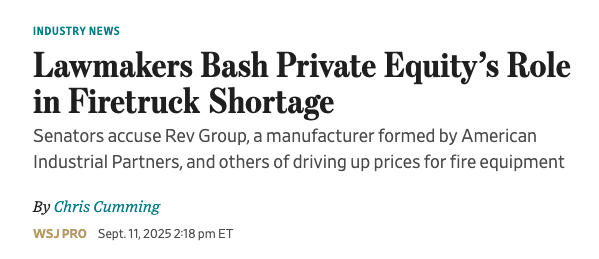
Basel Musharbash, a lawyer who testified in front of Congress and wrote an article just following the fires titled: “Did a Private Equity Fire Truck Roll-Up Worsen the L.A. Fires?” outlined the problem in detail. “The cost of fire trucks has skyrocketed in recent years—going from around $300-500,000 for a pumper truck and $750-900,000 for a ladder truck in the mid-2010s, to around $1 million for a pumper truck and $2 million for a ladder truck in the last couple years.”
Private equity had consolidated the Fire Truck industry in America, and began increasing prices while simultaneously decreasing product quality—a typical PE formula—creating increased profits for REV Group’s private equity owners American Industrial Partners (AIP). Even worse than the cost, wait times for new trucks more than quadrupled from under a year to over four years—creating a large backlog that the AIP-installed CEO repeatedly bragged about as “financially attractive” for its positive impact on revenue visibility in K-1s and earnings calls. In 2024, REV Group’s fire truck division grew profits an exceptional 8.9 percent while AIP simultaneously “sold nearly all of its shares, but before doing so awarded a special dividend of $180 million of which nearly $80 million went to AIP.”
While REV Group has undoubtedly been a success for AIP and made its partners much wealthier (it made at least one AIP partner a billionaire), the company highlights the seriousness and potential pitfalls of the short-term profit-above-all-else ethos (feel free to use the corresponding euphemism “fiduciary duty” if that offends your sensibilities) that is the heart of the private equity industry. But, as Arkansas fire chief Gil Carpenter put it: “When is enough enough? And at what point are you going to sacrifice public safety for profits?”
It would be a mistake to understand this as a case of capitalism gone wrong. Adam Smith, the father of modern capitalism, believed that complete separation of management and shareholders created a serious risk to society. He believed this so seriously that the final sentence of Book 1 ends with the warning that pure shareholders (à la modern private equity fund ‘investors’) are “an order of men, whose interest is never exactly the same with that of the public, who have generally an interest to deceive and even to oppress the public, and who accordingly have, upon many occasions, both deceived and oppressed it.”
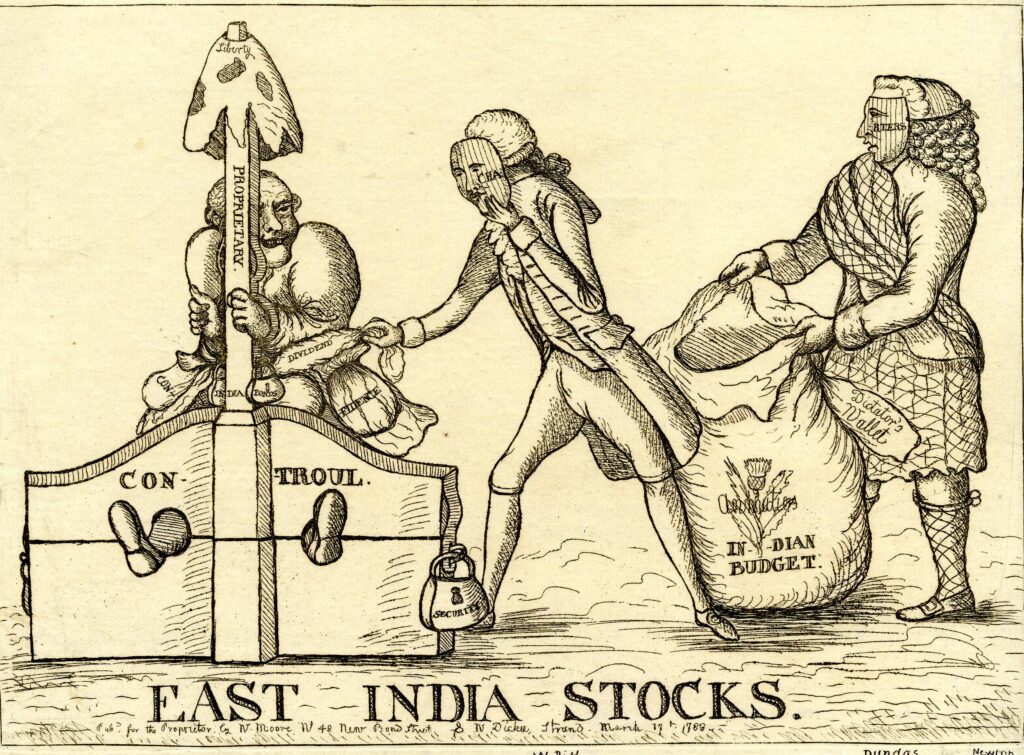
In Book IV Chapter 7, Smith calls out the East India Company practice of destroying entire fields of harvestable crops to create scarcity for the sole reason “that extraordinary profit was likely to be made.” Is this any different from the REV Group’s practice of acquiring fire truck manufacturing facilities, only to close them shortly after acquisition resulting in longer repair and delivery wait times and an over-inflated order backlog, which the PE-installed CEO repeatedly referred to as financially attractive? If Adam Smith wouldn’t use the term Capitalist to describe either company’s leadership, what would he call them?
Decades ago, the fire truck industry looked very similar to the ERP industry, with many small, specialized companies manufacturing and repairing fire trucks for their local markets. Today, three companies—REV Group, Oshkosh (Pierce Manufacturing), and Rosenbauer—have nearly 80% market share. The short-term profit-maximizing incentives associated with private equity ownership creates bad behavior, which only gets worse as industries consolidate and concentrate.
At Mirador, we’re working against private equity consolidation of the ERP industry, because we’ve seen the perverse incentives and their damaging consequences. While they haven’t reached the severity of threatening human lives—it doesn’t make them any less palatable for the customers and employees who suffer as PE firms consolidate and subsequently weaken companies in the name of short-term profit.
In the words of the late Charlie Munger, “show me the incentive, and I’ll show you the outcome.”
Incentives are ultimately decided by ownership.
We are different because we believe in remaining independently-owned and owner-operated to retain our long-term focus and customer-centric strategy. We believe that you can’t know what’s best for a company if you don’t work in that company, and you can’t know what’s best for a customer or employee if all they are to you is a row on a spreadsheet.
What do you think about the impact PE consolidation is having on other markets? I’d love to discuss it, so reach out to me on LinkedIn or send us an email.
If you’re running a growing business, chances are you don’t spend a ton of time thinking about your finance organization. For many small business founders, “finance” means making sure the books are closed, taxes are filed, and bills get paid on time. Necessary? Absolutely. Strategic? Not really.
But here’s the thing: the way you view finance can shape the future of your business. Done right, it’s not just about compliance — it can actually help drive growth, improve profitability, and even increase the value of your company when the time comes to sell.
Let’s break it down.
The Traditional Role of Finance: Support Mode
In many early-stage or organically grown companies, finance tends to stay in the background. Think of it as the team that makes sure the trains run on time:
Important? Of course. But when finance is only seen as a cost center, you miss out on a huge opportunity.
The Strategic Role of Finance: Driving Value
As companies mature, finance shifts from support mode to growth mode. Instead of just keeping score, finance helps call the plays.
Here’s what that looks like:
Baby Steps: How to Get Started Today
If you’re a founder, you don’t need to turn finance into a strategic powerhouse overnight. But you can start small. Here are a few ways:
Thinking Ahead: The Long Game
Even if selling your business isn’t on your radar today, it’s worth planning as if you might one day. Buyers pay more for companies with strong financial discipline, reliable data, and a track record of making strategic decisions. That doesn’t mean you need to run your company like a Fortune 500 business — but it does mean putting the building blocks in place now so you’re ready when opportunity knocks.
Throughout my career, I have had the privilege of managing many types of business, ranging from high-growth start-ups to mature, private equity-backed consolidation groups. I have also had the opportunity to serve customers ranging from SOHO’s to Fortune 500 enterprises. What I’ve come to realize is that what I most enjoy is everything in between—or, in other words—the midmarket.
Over the last two decades, I’ve had the privilege of helping to acquire founder-led businesses. These entrepreneurs had the vision to see a problem and the ambition to build a business around solving it. That initial growth journey—building out a proven product for a niche market—often takes a lifetime, and it’s so incredibly inspiring.
The skillset required to get that first 10 million is often very different from the skillset required for the 10-100 million journey. There’s no insult there, because I’m no founder, and I’ve met plenty of founders with no interest in the midmarket growth journey—which is what I know how to do, and what I’ve come to realize I love to do.
By far, the most rewarding aspect of the job is witnessing the professional development of the people in these businesses. The honor of my career has been mentoring young, sometimes second-generation management teams and unlocking their big ideas.
I also really enjoy the speed of execution that comes with the midmarket growth journey. The companies are still too small for bureaucracy, and the people are deeply loyal and knowledgeable. It’s an environment where small but enlightened teams can achieve tangible results quickly, and where success is extremely personal.
I also love witnessing the impact of growth initiatives—particularly from a customer perspective. Sometimes even simple changes to their service experience or a single product release can have transformative value creation and turn happy customers into true ambassadors.
At Mirador, our strategic aim is to enable the continuous business process improvement of our customers through ERP software.
In the world of midmarket ERP, success isn’t about being the lowest-cost provider or having the flashiest features. Multiples of what’s saved on a cheap ERP implementation is lost in wasted materials or poor inventory management, faulty project or job costing, and a lack of real-time data to drive informed decisions on the shop floor and the board room — and everywhere between. Flashy features from more horizontal providers look great in demos, but end up fitting the company to the system, not the other way around. They’ll pitch this as a virtue claiming “best practice,” which really just means “industry average.” We believe in becoming a true partner to our customers, helping them navigate complexity with tailored solutions, deep expertise, and a long-term commitment to continuous improvement.
ERP systems aren’t plug-and-play. They touch every aspect of a business—from production to inventory, finance, and customer service. They are the system of record. Each company has its own workflows, challenges, and strategic goals that make up its unique competitive advantage. A generic ERP system constantly drags a company toward generic operations.
That’s where customer intimacy comes in. It’s the discipline of deeply understanding each customer’s business, industry, and evolving needs. It means investing the time to learn how they operate, collaborating on customizations and product roadmap, and staying close well after go-live to ensure continued success. This kind of relationship doesn’t scale easily. It takes patience and steady, deliberate investment.
We’ve found that the midmarket is underserved when it comes to this level of care. Many ERP providers chase scale through standardization, leaving customers to adapt themselves to rigid systems. At Mirador, we go the other direction—we adapt to our customers. Our product management process is customer-driven. A refrain in roadmap meetings is that “we have 1,000 of the best product managers in our customer base.” We foster a service culture built on listening and responsiveness.
Choosing customer intimacy also aligns with how we view the role of ERP software: not as a product, but as a strategic lever. When implemented thoughtfully, ERP can improve competitiveness, enable growth, and strengthen the customer’s position in their own market. That can’t happen without a provider that truly understands their business.
In a category increasingly dominated by short-term thinking and financial engineering, we’re committed to long-term partnerships, local presence, and building trust over time. Customer intimacy isn’t just our strategy—it’s our identity.