Let’s chat.
We’d love to learn more about you and your business.
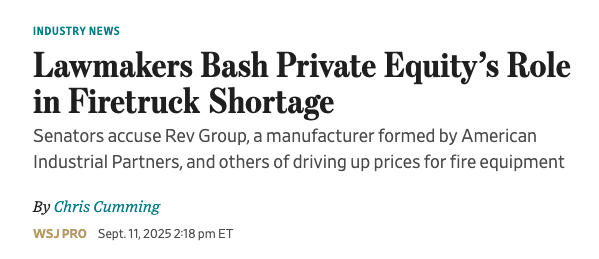
On the eve of September 11th, 2025, members of Congress called the private equity fire truck roll-up REV Group to testify about their business and its impacts on fire safety in America. I encourage anyone interested to watch the full hearing on the Senate website: Sounding the Alarm: America’s Fire Apparatus Crisis.
The Wall Street Journal’s headline sums it up well:
Basel Musharbash, a lawyer who testified in front of Congress and wrote an article just following the fires titled: “Did a Private Equity Fire Truck Roll-Up Worsen the L.A. Fires?” outlined the problem in detail. “The cost of fire trucks has skyrocketed in recent years—going from around $300-500,000 for a pumper truck and $750-900,000 for a ladder truck in the mid-2010s, to around $1 million for a pumper truck and $2 million for a ladder truck in the last couple years.”
Private equity had consolidated the Fire Truck industry in America, and began increasing prices while simultaneously decreasing product quality—a typical PE formula—creating increased profits for REV Group’s private equity owners American Industrial Partners (AIP). Even worse than the cost, wait times for new trucks more than quadrupled from under a year to over four years—creating a large backlog that the AIP-installed CEO repeatedly bragged about as “financially attractive” for its positive impact on revenue visibility in K-1s and earnings calls. In 2024, REV Group’s fire truck division grew profits an exceptional 8.9 percent while AIP simultaneously “sold nearly all of its shares, but before doing so awarded a special dividend of $180 million of which nearly $80 million went to AIP.”
While REV Group has undoubtedly been a success for AIP and made its partners much wealthier (it made at least one AIP partner a billionaire), the company highlights the seriousness and potential pitfalls of the short-term profit-above-all-else ethos (feel free to use the corresponding euphemism “fiduciary duty” if that offends your sensibilities) that is the heart of the private equity industry. But, as Arkansas fire chief Gil Carpenter put it: “When is enough enough? And at what point are you going to sacrifice public safety for profits?”
It would be a mistake to understand this as a case of capitalism gone wrong. Adam Smith, the father of modern capitalism, believed that complete separation of management and shareholders created a serious risk to society. He believed this so seriously that the final sentence of Book 1 ends with the warning that pure shareholders (à la modern private equity fund ‘investors’) are “an order of men, whose interest is never exactly the same with that of the public, who have generally an interest to deceive and even to oppress the public, and who accordingly have, upon many occasions, both deceived and oppressed it.”
In Book IV Chapter 7, Smith calls out the East India Company practice of destroying entire fields of harvestable crops to create scarcity for the sole reason “that extraordinary profit was likely to be made.” Is this any different from the REV Group’s practice of acquiring fire truck manufacturing facilities, only to close them shortly after acquisition resulting in longer repair and delivery wait times and an over-inflated order backlog, which the PE-installed CEO repeatedly referred to as financially attractive? If Adam Smith wouldn’t use the term Capitalist to describe either company’s leadership, what would he call them?
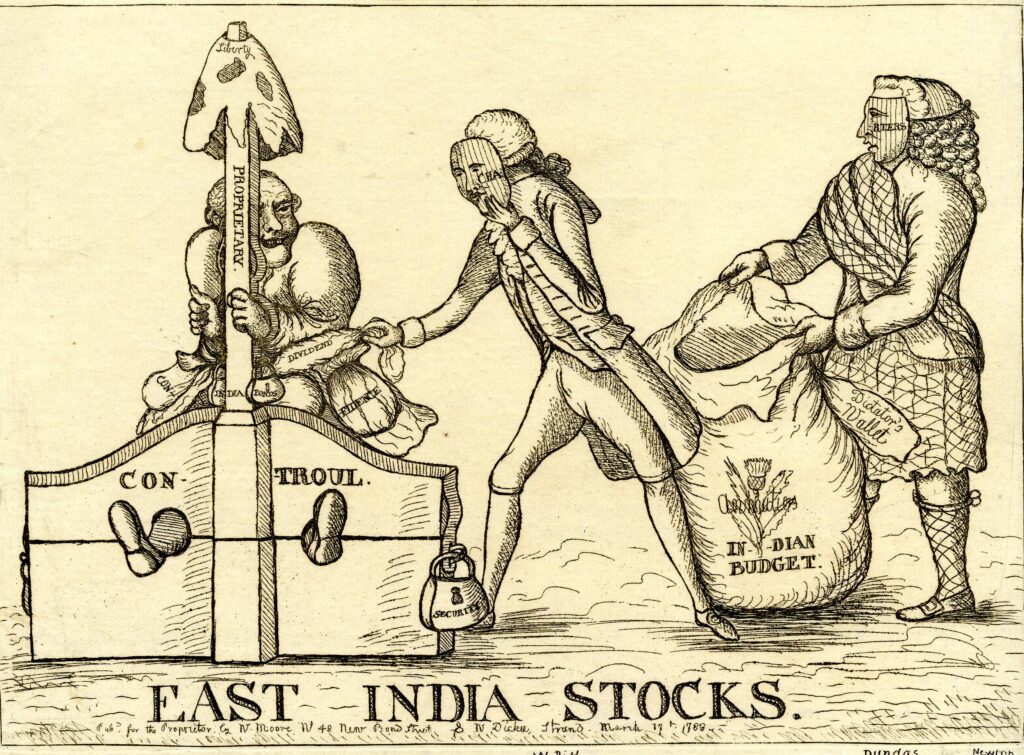
Decades ago, the fire truck industry looked very similar to the ERP industry, with many small, specialized companies manufacturing and repairing fire trucks for their local markets. Today, three companies—REV Group, Oshkosh (Pierce Manufacturing), and Rosenbauer—have nearly 80% market share. The short-term profit-maximizing incentives associated with private equity ownership creates bad behavior, which only gets worse as industries consolidate and concentrate.
At Mirador, we’re working against private equity consolidation of the ERP industry, because we’ve seen the perverse incentives and their damaging consequences. While they haven’t reached the severity of threatening human lives—it doesn’t make them any less palatable for the customers and employees who suffer as PE firms consolidate and subsequently weaken companies in the name of short-term profit.
In the words of the late Charlie Munger, “show me the incentive, and I’ll show you the outcome.”
Incentives are ultimately decided by ownership.
We are different because we believe in remaining independently-owned and owner-operated to retain our long-term focus and customer-centric strategy. We believe that you can’t know what’s best for a company if you don’t work in that company, and you can’t know what’s best for a customer or employee if all they are to you is a row on a spreadsheet.
What do you think about the impact PE consolidation is having on other markets? I’d love to discuss it, so reach out to me on LinkedIn or send us an email.
At Mirador, our strategic aim is to enable the continuous business process improvement of our customers through ERP software.
In the world of midmarket ERP, success isn’t about being the lowest-cost provider or having the flashiest features. Multiples of what’s saved on a cheap ERP implementation is lost in wasted materials or poor inventory management, faulty project or job costing, and a lack of real-time data to drive informed decisions on the shop floor and the board room — and everywhere between. Flashy features from more horizontal providers look great in demos, but end up fitting the company to the system, not the other way around. They’ll pitch this as a virtue claiming “best practice,” which really just means “industry average.” We believe in becoming a true partner to our customers, helping them navigate complexity with tailored solutions, deep expertise, and a long-term commitment to continuous improvement.
ERP systems aren’t plug-and-play. They touch every aspect of a business—from production to inventory, finance, and customer service. They are the system of record. Each company has its own workflows, challenges, and strategic goals that make up its unique competitive advantage. A generic ERP system constantly drags a company toward generic operations.
That’s where customer intimacy comes in. It’s the discipline of deeply understanding each customer’s business, industry, and evolving needs. It means investing the time to learn how they operate, collaborating on customizations and product roadmap, and staying close well after go-live to ensure continued success. This kind of relationship doesn’t scale easily. It takes patience and steady, deliberate investment.
We’ve found that the midmarket is underserved when it comes to this level of care. Many ERP providers chase scale through standardization, leaving customers to adapt themselves to rigid systems. At Mirador, we go the other direction—we adapt to our customers. Our product management process is customer-driven. A refrain in roadmap meetings is that “we have 1,000 of the best product managers in our customer base.” We foster a service culture built on listening and responsiveness.
Choosing customer intimacy also aligns with how we view the role of ERP software: not as a product, but as a strategic lever. When implemented thoughtfully, ERP can improve competitiveness, enable growth, and strengthen the customer’s position in their own market. That can’t happen without a provider that truly understands their business.
In a category increasingly dominated by short-term thinking and financial engineering, we’re committed to long-term partnerships, local presence, and building trust over time. Customer intimacy isn’t just our strategy—it’s our identity.